
I have a lot of nostalgia for the Twisted Metal series. I played countless hours of Twisted Metal 2 with a friend at his house as a kid. When I finally got a PlayStation, the first game I got was Twisted Metal 2. I dumped even more time into that game. I got the first Twisted Metal game later. Although I did not like it as much as the second game, I still enjoyed it. I like the series so much, that I followed two of its key creators, David Jaffe and Scott Campbell, throughout their careers.
SingleTrac started the Twisted Metal series. SingleTrac was spun off from a 3D simulator company. Scott Campbell would produce one of their first games, Twisted Metal, and David Jaffe would co-design with Mike Giam. Twisted Metal was a success, and a sequel was greenlit. This time, David Jaffe and Scott Campbell would co-produce the game. After the release of Twisted Metal 2, SingleTrac and Sony parted ways due to a contractual dispute. They were bought by GT Interactive, who would publish their third car combat game, Rogue Trip: Vacation 2012. Rogue Trip was produced by Scott Campbell. David Jaffe wouldn’t show up in video game credits again until Twisted Metal: Black.
It had been well over a decade since I played the first two Twisted Metal games, and I was excited to play them again for some RetroAchievements. In 2024, I discovered SingleTrac made a third car combat game, and I bought a used copy of Rogue Trip. Of the three games, it became the first one I played this year.
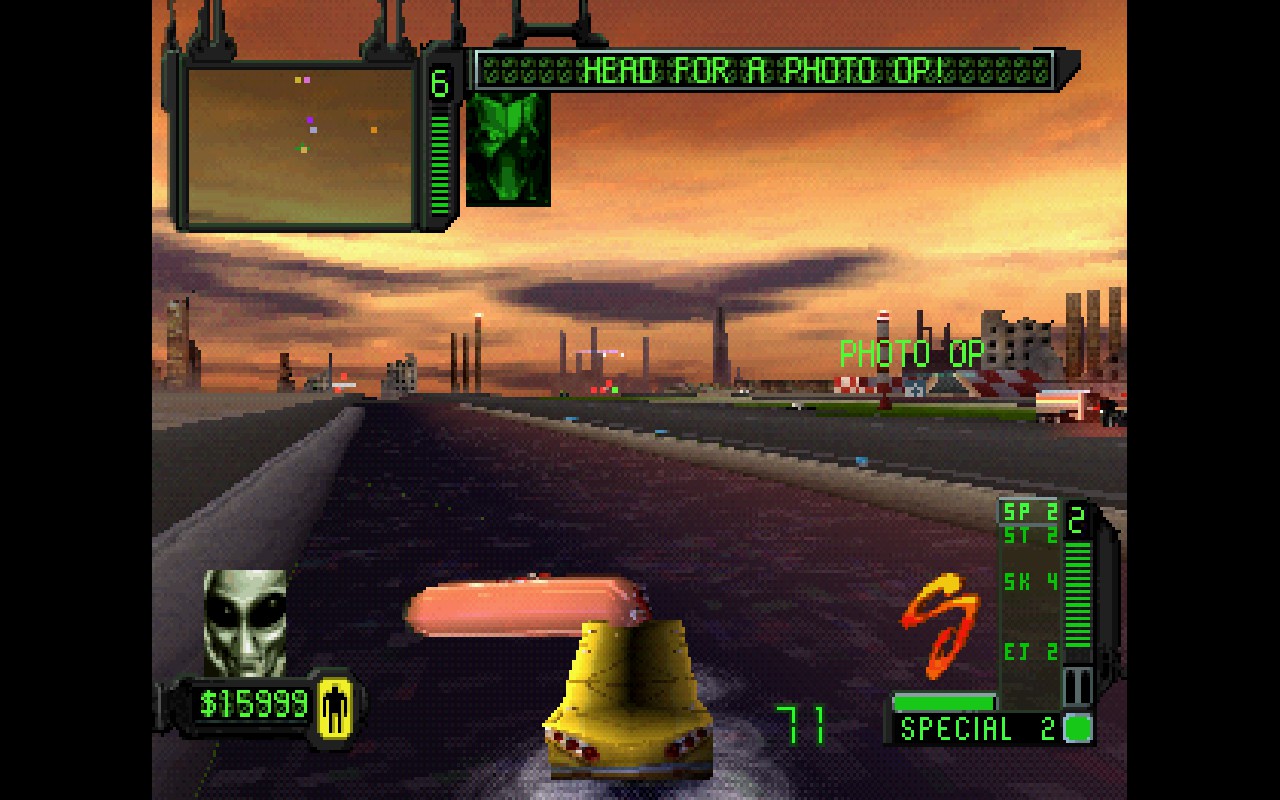
Rogue Trip: Vacation 2012 takes place in the future year of 2012 where the world has devolved into an apocalyptic hellscape. Big Daddy offers vacations from the apocalypse to the rich and elite. For the tourists on a budget, Auto-mercenaries will sneak them into Big Daddy’s resorts for some photo ops. To stay competitive on prices, Auto-mercenaries will literally fight for their fares. It has a neat premise.
Rogue Trip is very much Twisted Metal meets Crazy Taxi. The primary objective is to destroy all other Auto-mercenaries on the map. Rogue Trip adds a secondary objective to collect the tourist, and get them to their photo ops. Doing so nets some cash, which can be used for weapon upgrades and healing. It plays very much like king-of-the-hill, where you do not want to lose the tourist once you have it. There is a weapon that ejects the tourist from a vehicle. If the car with the tourist dies, then the tourist is also ejected.
Rogue Trip plays very much like Twisted Metal 2. I spent most of my time collecting weapons, and shooting them at enemies. SingleTrac created a new arsenal from Twisted Metal, probably to avoid being sued by Sony. Spending money to upgrade the weapons usually adds more damage, but can also add additional homing capabilities. My personal favorite was the Meteor, which rained meteor’s from the sky. Much like Twisted Metal, there is an energy meter. When I input the right combo, I was able to use the energy to enable shields, shoot backwards, jump, etc. I felt right at home playing Rogue Trip, and consider it a Twisted Metal game.
SingleTrac proved they had keen level design skills with the first two Twisted Metal games. Rogue Trip continues that trend. I rarely felt trapped, and the weapons were well placed in Rogue Trip. Each level is based on a real-world location, like Las Vegas and Washington D.C., but they have a fun twist. Most of the levels have destructible barriers, opening up more weapons. Although Rogue Trip never reaches the highs of Twisted Metal 2, I think the levels are still excellent. Neon Nightmare, the level based on Las Vegas, is my favorite. It has a giant slot machine, which can give or take. After breaking down a barrier, most of the buildings can be entered. The reward is a cache of weapons, but can get you cornered. It’s well designed overall.
The music is good, however, there is a problem. Matches can last 10 to 15 minutes, and the songs are very short. The game just loops the same two to three minute song over and over in the same match. The songs do not have a natural transition between the end and start. Instead, it is a hard stop and start, which is jarring. I find it odd that SingleTrac couldn’t solve this problem in Rogue Trip, because it is not a problem in the first two Twisted Metal games. I found myself hating some of the songs after playing a level, despite being good battle music.
The stories in Rogue Trip are disappointing. Like Twisted Metal, each car has a backstory and personality. However, the endings are basically the same with one throw away line relating back to the specific car. Nothing interesting happens for beating the game, which is a poor payoff. I only played through the game two times. I might revisit and play some other characters someday. Instead of playing more Rogue Trip, I decided to see how SingleTrac’s first car combat game held up.
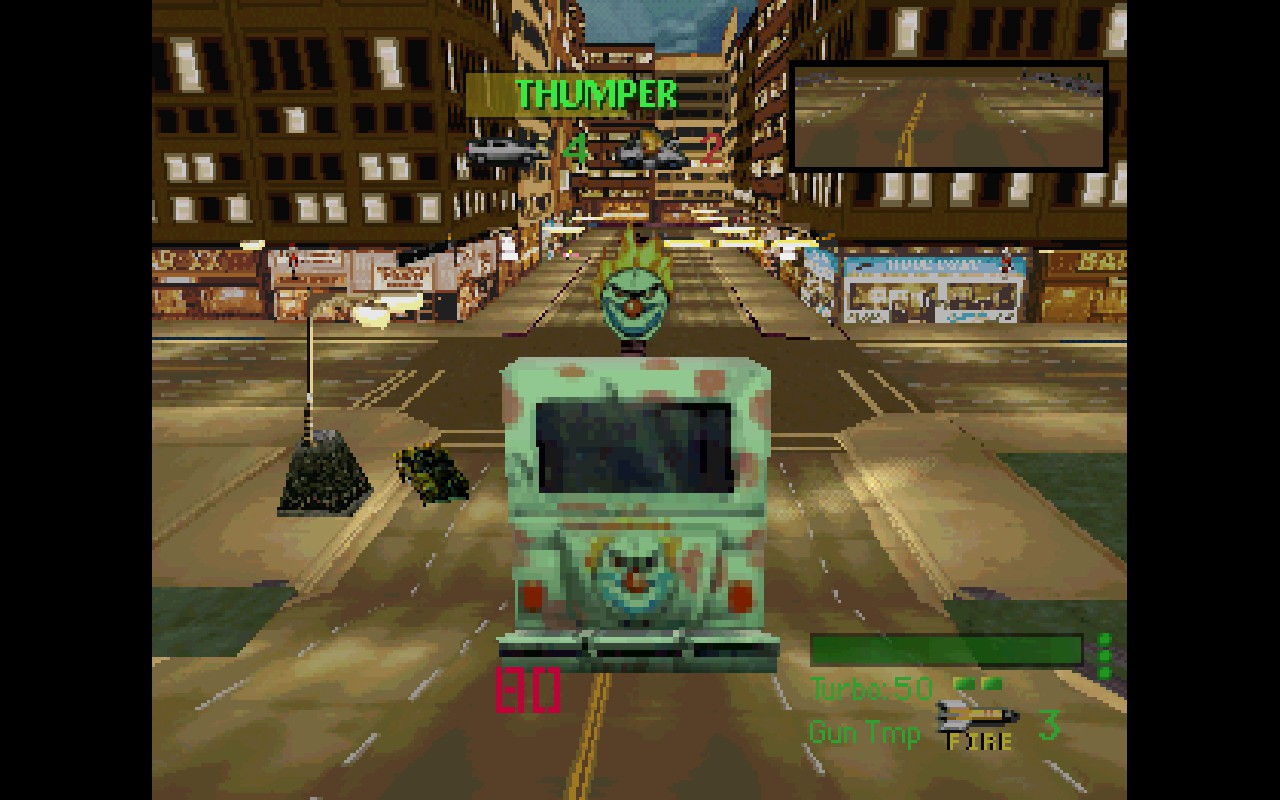
Immediately, I noticed the music in Twisted Metal. The music in the first game is better than Rogue Trip’s by far. It is the perfect soundtrack, and I never noticed the looping despite it looping the same song in a level. It is basically just instrumental metal music, which is perfect for a car combat game. I would have liked a little more variety in genre and in the number of songs, but I never got sick of the soundtrack. It’s weird, because I remember turning off the music when I played both Twisted Metal and Twisted Metal 2 as a kid. Never again.
The combat arenas in Twisted Metal are well designed. Twisted Metal is missing the environmental destruction from later games, but fights are still fun. I wish there was more variety in their looks. I get the levels are supposed to take place within LA, but the arenas feel too similar to one another. There are no iconic landmarks, but Cyburbia and Rooftops do stand out. Rooftop stood out just because I could fall to my death. Cyburbia had the variety I was craving for the rest of the game. It has residential streets, highways, and a drainage canal. It looks cool, but it is too big for actual fighting. I spent too much time looking for opponents.
The Twisted Metal series doesn’t have an official canon, but they tend to have the same setup. Calypso hosts a car combat tournament, and the winner of the tournament is granted one wish. Over the series, Calypso has had the ability to grant wishes for various reasons. Each character always has a backstory, and a specific wish they are seeking. In the first game, the backstories are very cheesy and feel like an afterthought, but I find them charming. There is a little bit of lore intertwined within some of the endings relating to Calypso’s powers. Later games lean into Monkey’s Paw type endings, but Twisted Metal’s endings are mostly straight forward. If you have a chance, check the live action endings found in Twisted Metal Head-On: Extra Twisted Edition.
The weapons are a big mixed bag. The Special weapons don’t feel unique, and most of them aren’t good. Crimson Fury and Darkside share similar specials, and they only shoot in straight lines. Similarities can be found with other characters as well. I mostly used a variety of missiles, because the non-missile weapons suck. Oil slicks, tire spikes, and drop mines are useless against the AI, and only serve to annoy the player. I did find the machines guns effective, but they have a cool down if used too much.
When I play these games, I drive around and collect as many weapons as I can, and then focus on one enemy at a time to try and annihilate them. Twisted Metal makes it difficult to collect weapons. The weapon pickups look like bubbles, and the picture of the weapon inside of the bubble is too small for me to see. I’d see the “weapon bay full” message, and have to drop 10 oil slicks from my inventory. It was problematic when I just wanted to collect weapons, but was also dodging enemy attacks. It’s not good, and I had to rely on memorizing where the good weapons were located.
The movement is the worst part of the first Twisted Metal. Many of the impacts cause the vehicle to jump into the air, and turn to the side. Usually, it turns into a wall, killing all momentum. It feels bad in a “high octane” game like this series. Whenever this happened, I was forced to reverse away from the wall, and then turn away from it, since the game required me to move to be able to turn. Twisted Metal 2 solves this issue by just allowing you to turn your vehicle, even if you are at a complete stop. Being stopped for so long in the first game is bad, because it means the AI will spam attacks at you, usually causing you to turn into another wall. It is a vicious cycle.
The AI is batty in this game. AI vehicles will only use two weapons. For example, Sweet Tooth used his special and drop mines. They’ll have infinite ammo, which is a bit unfair. However, they also ignore weapons on the map, leaving them for you to pickup. It is an odd balance. The AI just kind of drives around without any thought behind it. I spent a lot of time looking at my radar looking for enemies. Very rarely do they attack other AI vehicles.
I am really surprised the first Twisted Metal sold so well. Overall, it is a bad game with some good idea and well designed maps. Thankfully, we got a sequel.
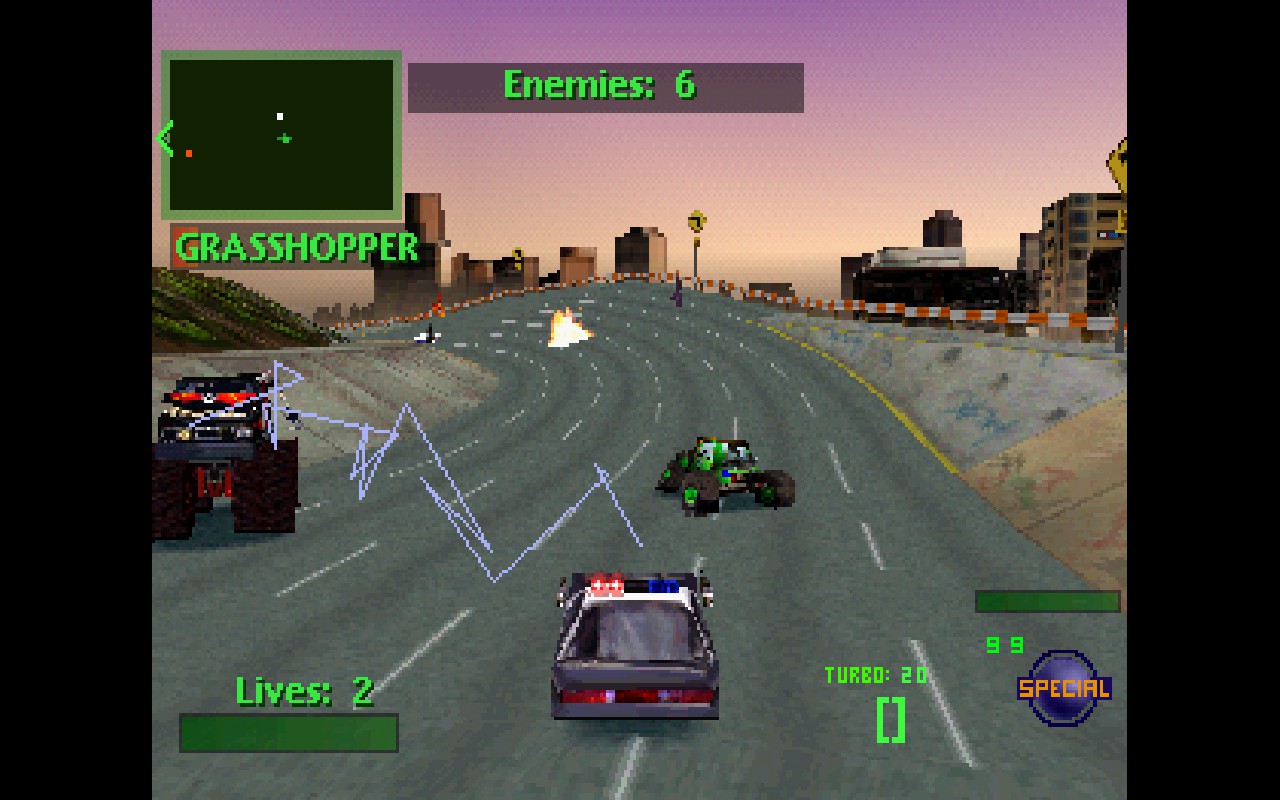
SingleTrac knows how to design a level, and Twsited Metal 2 is there best work in that regard. Many of the maps are iconic. I found something cool in each map. Of course, blowing up the Eiffel Tower to unlock the rooftops is the highlight in Paris. The maps include several things to destroy, most of it leading to more weapons or health. It’s fun to pop in a secret area, collect a bunch of a weapons, and blow away an enemy.
They fixed all of the weapon problems from the first game. Each weapon pickup is large and has a unique icon. I could always tell if I am picking up a good weapons. Actually, all of the weapons are good, so this wasn’t really a problem in Twisted Metal 2. The game introduced a special meter, allowing me to shoot freeze missiles, jump, shoot backwards, and more. Most of them are useful to learn. The amount of damage dealt by each weapon felt right, and balanced.
Speaking of problems fixed in the sequel, Twisted Metal 2 feels so much better to play. Nothing caused my car to spin into a wall. There are only a few weapons, like the ricochet bomb, that will throw you back. However, they never spin you around (except Twister’s special). Movement and momentum are important for these games to work, and I never felt like I lost my speed in Twisted Metal 2. The only complaint I can come up with are the cars don’t have much heft to them. There are subtle weight differences among the vehicles, but they are not as pronounce as they should be. However, I am glad they prioritized fun over realism here.
The character stories are great. Each of the stories fit the characters, and the endings are fun. Calypso twists most of the wishes, but there are a few that get what they actually want. They aren’t masterpieces by any means, but they serve as good rewards for beating the game. I like the comic book artstyle of the cutscenes, and the voice actor for Calypso does a great job.
Maybe it’s my nostalgia for Twisted Metal 2, but I think it is the best Twisted Metal game for the PS1. It does most everything right. I’m glad that I still think it holds up after all these years.
Playing these three games made me really see SingleTrac’s strengths. They had strong level design chops and knew how to create 3D environments in an era where developers struggled to do so. With each game, they learned what works in a car combat game, and what doesn’t. This continued even after SingleTrac closed. Over the years, members of SingleTrac joined Incognito Entertainment and Eat Sleep Play. They took their experience and built upon it for Twisted Metal: Black and Twisted Metal: Head-On (which I will be replaying later). Although car combat games are mostly dead, the genre would not have been as popular as it was without SingleTrac. These are fun games, and you should check them out